Artificial intelligence is no longer just a tool for generating text, images, or answering questions. In 2026, AI is becoming an increasingly important part of scientific research, software development, data analysis, healthcare, engineering, and technological innovation.
The transformation is particularly significant in science. Modern AI systems can analyze enormous datasets, identify patterns, generate hypotheses, assist with experiments, and increasingly work as specialized research agents. The 2026 Stanford AI Index includes a dedicated science chapter covering AI applications across biology, chemistry, physics, and astronomy.
For organizations focused on science and technology, this shift creates new opportunities to solve problems faster while also introducing important questions about accuracy, safety, transparency, and human oversight.
AI Is Changing Scientific Research
Scientific research traditionally requires researchers to collect data, analyze results, develop hypotheses, design experiments, and validate conclusions.
AI can assist with many of these steps.
Machine-learning systems can process datasets that would be extremely difficult for humans to examine manually. AI can identify relationships between variables, classify complex information, simulate possible outcomes, and help researchers determine which questions deserve further investigation.
In some fields, AI is moving beyond prediction toward active participation in research. The UK government’s 2026 AI for Science strategy notes that AI systems are increasingly capable of generating hypotheses and designing experiments, while researchers are also exploring connections between AI systems and robotic laboratories.
AI and Drug Discovery
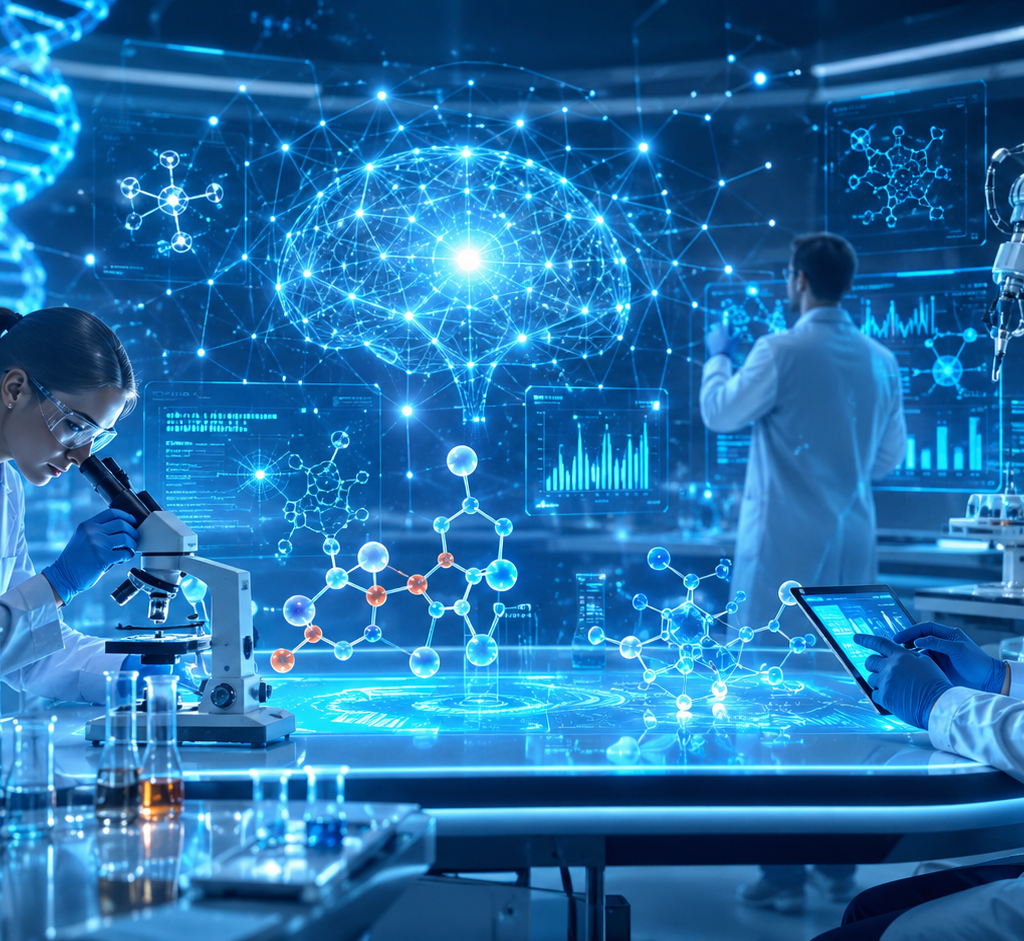
One of the most promising applications of AI is biomedical and pharmaceutical research.
Drug discovery can require years of research because scientists must evaluate huge numbers of biological and chemical possibilities. AI can help researchers analyze molecular structures, predict interactions, identify promising candidates, and prioritize experiments.
The UK government’s AI for Science strategy has identified faster drug discovery as its first major mission, with an ambition to help develop trial-ready drugs more rapidly.
AI is also being applied to protein science, medical imaging, diagnostics, and other areas of healthcare. The UN’s 2026 scientific panel report highlights applications including protein-structure prediction, drug design, and medical imaging.
However, AI does not eliminate the need for laboratory testing or medical expertise. AI-generated predictions must be experimentally and clinically validated before they can be trusted in real-world applications.
AI Is Revolutionizing Data Analysis
Modern organizations generate enormous amounts of data.
Scientific instruments, satellites, medical systems, businesses, sensors, websites, and software applications can produce millions or billions of data points.
Traditional data-analysis methods can struggle when datasets become extremely large or complex. AI can help researchers and organizations process this information more efficiently.
AI-powered data analysis can be used to:
- Detect patterns in large datasets
- Identify unusual or unexpected results
- Predict future trends
- Automate repetitive analytical tasks
- Classify images and documents
- Discover relationships between variables
- Support complex decision-making
This makes AI particularly valuable for scientific research, where meaningful discoveries may be hidden inside enormous datasets.
AI in Software Development
Software development is another area experiencing rapid change.
AI coding systems can help developers generate code, explain unfamiliar codebases, identify potential bugs, write tests, document software, and automate repetitive programming tasks.
The role of developers is therefore changing. Instead of spending all their time writing individual lines of code, developers can increasingly focus on system architecture, product requirements, security, testing, and reviewing AI-generated solutions.
AI can improve productivity, but human review remains essential. Generated code may contain bugs, security vulnerabilities, incorrect assumptions, or inefficient implementations.
For technology companies, the most effective approach is often a collaboration between experienced developers and AI tools rather than completely replacing human engineering.
AI Agents and Autonomous Workflows
One of the major developments in 2026 is the growth of AI agents.
Unlike traditional chatbots that primarily respond to individual prompts, AI agents can be designed to plan tasks, use software tools, access information, execute multiple steps, and work toward a defined objective.
In science, this could eventually mean AI systems helping researchers search scientific literature, develop hypotheses, plan experiments, analyze results, and coordinate laboratory equipment.
The 2026 Stanford AI Index reports growing activity around agent systems in scientific fields, including physics, astronomy, chemistry, and materials science.
This does not mean that scientists will disappear. Instead, researchers may increasingly work with AI as a research partner capable of handling computationally intensive and repetitive tasks.
AI and Engineering
Engineering is also being transformed by artificial intelligence.
AI can assist engineers with simulation, optimization, predictive maintenance, design exploration, and system monitoring.
For example, instead of testing thousands of possible designs individually, AI models can help identify promising configurations that engineers can evaluate more closely.
AI can also analyze sensor data from machines and infrastructure to detect signs of failure before a major breakdown occurs.
This combination of AI, sensors, robotics, and advanced computing could contribute to smarter factories, vehicles, energy systems, and infrastructure.
AI in Astronomy and Space Science
Space science generates enormous quantities of information.
Telescopes and satellites continuously collect images and measurements that scientists must analyze. AI can help classify astronomical objects, detect unusual signals, analyze images, and prioritize observations.
AI agents are already being explored for astronomy-related workflows. The 2026 AI Index, for example, documents systems that automate aspects of astronomical observation planning.
As instruments become more powerful, AI-assisted analysis will become increasingly important for extracting useful information from massive scientific datasets.
AI and Education
AI is also changing how people learn science and technology.
Students can use AI systems to receive explanations, practice programming, explore mathematical concepts, summarize difficult subjects, and receive personalized assistance.
Teachers and institutions can use AI to develop educational materials, analyze learning patterns, and create interactive learning experiences.
However, education systems must ensure that students develop genuine understanding rather than simply depending on AI-generated answers.
The goal should be to use AI as a learning assistant while continuing to develop human reasoning, creativity, communication, and critical-thinking skills.
The Importance of Responsible AI
The rapid development of AI creates significant opportunities, but it also introduces risks.
AI systems can produce inaccurate information, amplify biases, expose sensitive information, or make decisions that are difficult to understand. More autonomous systems create additional concerns because they may perform multiple actions with limited human intervention.
The UN’s 2026 independent scientific panel has emphasized both the potential benefits of AI and the risks associated with rapid, unchecked deployment.
This makes responsible AI development increasingly important.
Organizations using AI should consider:
- Accuracy and reliability
- Data privacy
- Cybersecurity
- Transparency
- Human oversight
- Bias and fairness
- Model evaluation
- Environmental impact
- Regulatory requirements
NIST’s 2026 AI program is also emphasizing measurement, testing, evaluation, standards, and risk-based approaches to trustworthy AI.
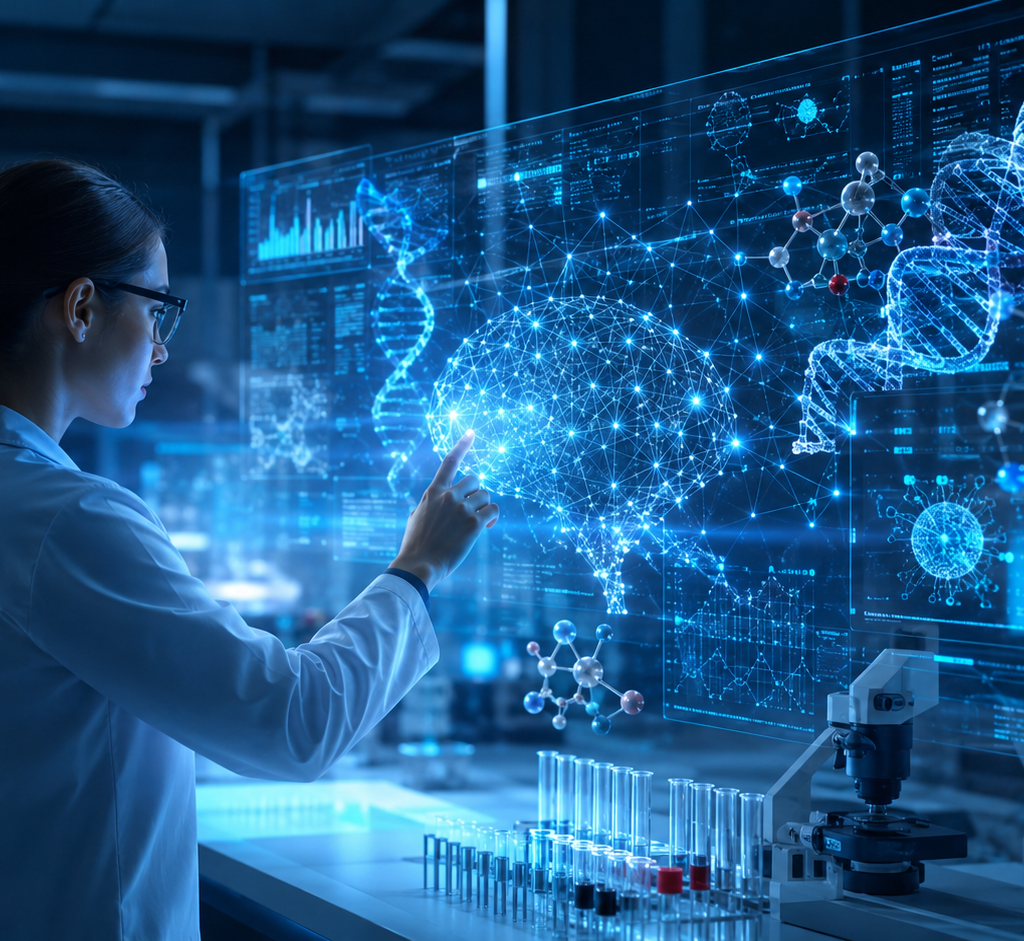
AI Will Not Replace Science — It Will Change How Science Is Done
A common question is whether AI will replace scientists, engineers, and developers.
The more realistic possibility is that AI will change their workflows.
Researchers may spend less time searching through massive datasets and more time deciding which questions are scientifically meaningful.
Developers may spend less time writing repetitive code and more time designing reliable systems.
Engineers may use AI to explore more possible solutions before selecting the best design.
Scientists may use AI to identify promising hypotheses before conducting physical experiments.
Human expertise will remain important because scientific discovery requires judgment, experimentation, interpretation, and accountability.
The Future of AI-Powered Innovation
The next stage of AI development will likely involve deeper integration between software, scientific models, robotics, specialized hardware, and real-world systems.
AI systems may increasingly connect directly with laboratories, manufacturing equipment, scientific instruments, and enterprise software.
This could create a new research model in which humans define goals while AI systems handle parts of the discovery and execution process.
At the same time, access to computing power, high-quality data, skilled researchers, and advanced infrastructure will influence which countries and organizations benefit most from AI.
International organizations have therefore emphasized the importance of inclusive AI development, open science, responsible data practices, and global collaboration.
Conclusion
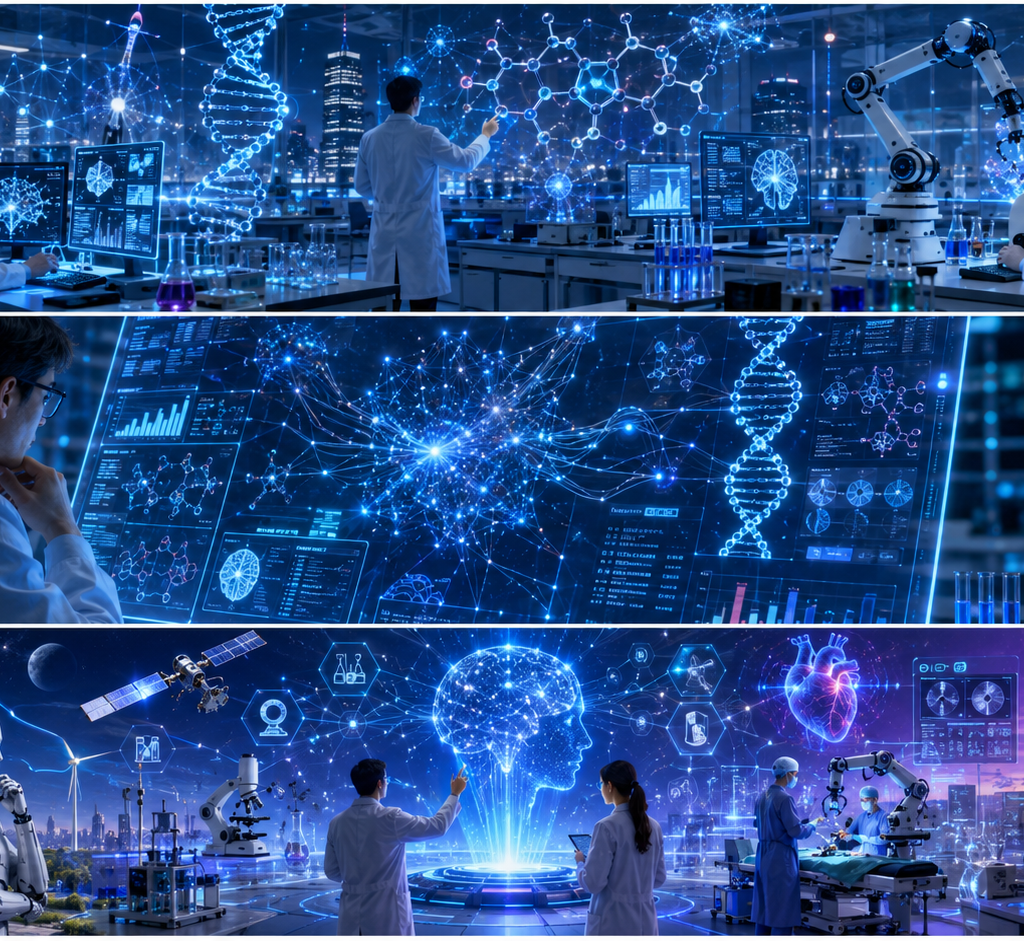
Artificial intelligence is becoming a powerful force across science and technology in 2026.
From scientific discovery and drug research to data analysis, software development, engineering, astronomy, and education, AI is helping humans process information and explore possibilities at a scale that was previously difficult to achieve.
The biggest opportunity is not simply to automate existing tasks. It is to use AI to discover new approaches to problems that were previously too complex, expensive, or time-consuming.
At the same time, responsible development must remain a priority. Reliable evaluation, human oversight, privacy, security, transparency, and scientific validation will be essential as AI systems become more capable.
The future of science and technology will therefore not be simply AI versus humans. It will increasingly be about humans and AI working together to solve problems, accelerate discovery, and build better technologies.
For technology-focused organizations such as GrokAI, this evolving relationship between artificial intelligence, science, software, and data represents one of the most important technological opportunities of the decade.